

Why power of attorney registration is in a jam in Scotland — and what is being done to fix it

An update from the Office of the Public Guardian on the PoA wait time position.
The Office of the Public Guardian (OPG) in Scotland is part of the Scottish Courts and Tribunals Service (SCTS). OPG has provided a power of attorney (PoA) registration service since April 2001. Throughout this period OPG has been committed to delivering a high level of customer service. However, users familiar with the PoA registration service will be aware of the longstanding backlog and considerably long wait times for PoAs to be processed.
OPG would like to thank users for their patience and understanding during these challenging times. While the wait time position is far from ideal, please be assured that OPG is taking steps to reduce the backlog and not taking user patience for granted.
Background and context
The backlog and long wait time is largely due to the impact of the pandemic, the need for a new case management system, and a substantial increase in PoA submission rates and in the number of cases requiring maintenance. The volume of PoAs submitted for registration has increased each year, except during the pandemic year of 2020-21.
Last year more than 95,000 PoA submissions were received at OPG. This is an increase of 30% compared to 2016-17. OPG’s business continues to grow, with 27,997 PoA submissions received in the last quarter alone. OPG estimates that more than 100,000 submissions will be received this current year (2025-26).
The snapshot below outlines the number of PoAs received and processed by the PoA team in the last quarter (July–September 2025).
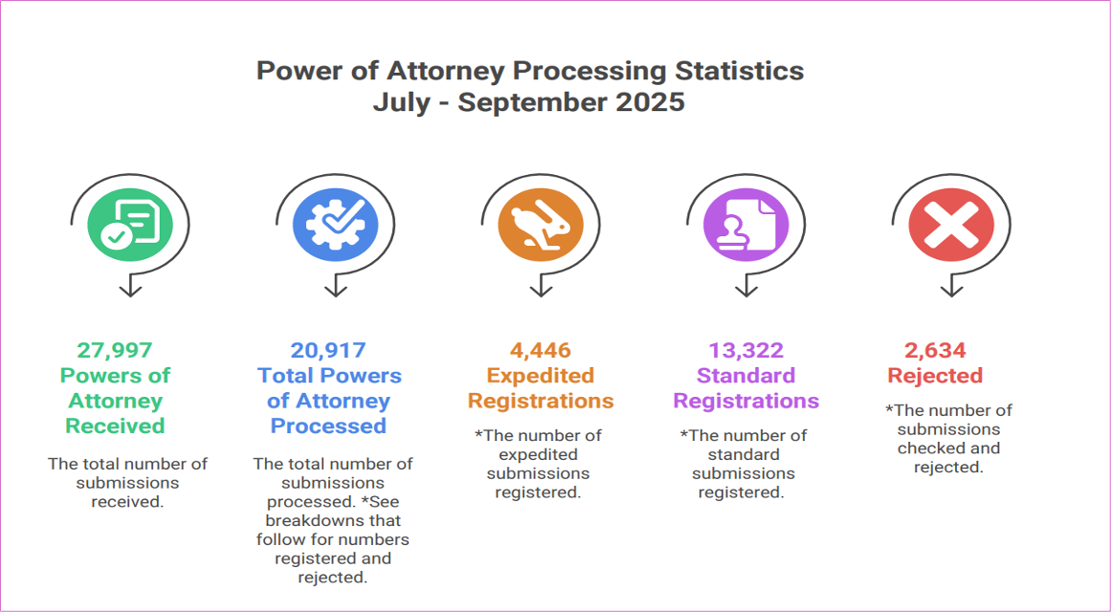
Those familiar with the PoA position will be aware that the current wait time has now reached 12 months. OPG acknowledges that this is not a satisfactory level of service, and every effort is being taken to work on the backlogs. OPG continually reviews its processes to work as efficiently possible. To keep users informed of current PoA wait times, information is published weekly on OPG’s website, X feed and telephone message.
It is appreciated that when there are long waiting times, there is a greater chance of an expedite being sought when there is a need for a PoA to be processed urgently. Submissions that meet OPG’s criteria for expedited registration (see below) are prioritised and processed ahead of standard submissions. For context, 1,564 PoAs were expedited in September 2025. The increase in demand for this service inevitably affects the wait time for standard submissions, and customers are asked to use this service only where there is a genuine urgency.
In addition to the increase in volume of PoA submissions, 900,000 live PoA cases are in the system, of which a substantial number will require maintenance. A similar pattern exists for this work and the number of cases requiring maintenance has steadily increased year by year. In 2024-25 a total of 29,795 cases required maintenance due to changes in the granter or attorney’s circumstances.
The snapshot below outlines the position over the last quarter and the number of items worked.
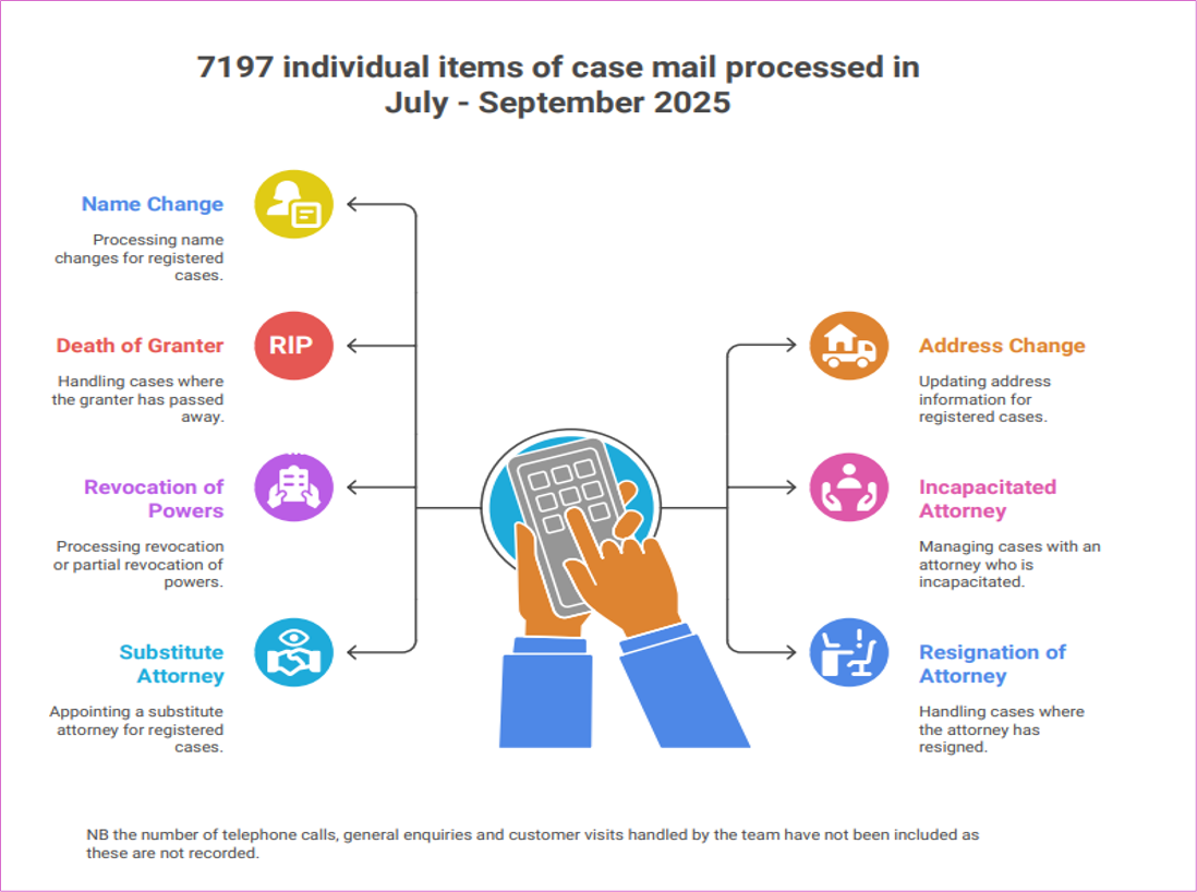
In addition to the substantial increase in the volume of work, the OPG case management system (Sigma), which is 25 years old, has had an impact on waiting times. The system has many issues including an extremely slow processing speed.
Steps taken
OPG has obtained significant investment from the Scottish Government and SCTS to replace Sigma. This will be done in three initial phases.
Phase 1 of the new system is in respect of all PoA workstreams. This phase began to go live in January 2025, with a relatively basic but functional version of the new system, PAIGE. As with all projects of this scale, it takes time to train staff, embed a new system, fix bugs and then develop the system further until it is at its optimal functioning state. This work has continued throughout the year.
The system, which has been developed on Microsoft Dynamics, will enable PoAs to be processed more efficiently, allow OPG to start tackling the backlogs and cope more readily with future demands on the service.
In addition to the above investment, funding was secured in 2025-26 to recruit additional temporary staff to assist in efforts to reduce the backlog. The staff are now fully trained and focused on processing PoAs. OPG staff are also working overtime to aid the recovery efforts where possible.
OPG wishes to reassure users that SCTS remains committed to improving and maintaining performance in this area and will continue to take all steps required to deliver a fast, efficient and reliable service.
Expedite service
Users are reminded that where there is an urgent need for a PoA to be processed, an expedited registration service is available. The examples below outline the type of urgent situations that meet the criteria of the expedited registration service.
The granter:
• has subsequently lost capacity and urgent decisions need to be made
• has been admitted to hospital and urgent action requires to be taken
• requires to be moved from hospital with a care package or into a care home
• is at risk of financial harm as they cannot act in their own interests to pay bills, care fees etc
• has been discharged from hospital and a financial assessment is to be undertaken
On receipt of an application to expedite a PoA, OPG will endeavour to process the application within five working days. OPG asks that this service is requested only when there is a genuine urgency; inappropriate use of the service creates avoidable delays for those in most need of the service.
Help OPG help you
Over the last quarter, July–September 2025, OPG returned 2,634 PoAs to the sender as they did not meet registration criteria. Time is spent on all PoAs received as they must be read, checked against the criteria and input in the system. Time was spent on 14% of submissions sent in the quarter and many of these submissions will be resubmitted and require processing, therefore they will be double handled. The top reasons for rejecting a PoA are:
1. Names stated on the PoA and on Schedule 1 (certificate of capacity) do not match
2. The date of interview on Schedule 1 was omitted or is not the same as the date the granter signed the PoA
3. Schedule 1 has not been completed fully at Section 5
4. No date of birth is provided for the granter (postal submissions)
5. Input on EPOAR is incorrect or incomplete (names misspelled or omitted; details of any substitutes not input)
OPG asks that senders take care to ensure documentation is fully completed, checked and correct before sending for registration.
On the horizon
OPG has aspirations to digitally transform its services. This will be possible with the continued investment by SCTS to roll out the new system. Phase 2 of the project will focus on the guardianship, intervention and access to funds functions of the business, as well as providing a customer-facing, 24/7 accessible Online Public Register. Phase 3 will migrate the functions of the Accountant of Court’s office and both are planned for release throughout 2026-27.
Once Phases 1–3 are complete, not only will existing services be more efficient, OPG will then have the platform to develop – subject to further funding – additional digital functionality for customers and transform the way in which users interact with OPG by introducing, for example, submission portals, ‘track my application’ and verification codes.
Laying down the law — Does Scotland have a problem writing legislation?
Weekly roundup of Scots law in the headlines including Lord Advocate's dual role, Dunblane and assisted dying — Monday March 16
Practical PR for Solicitors: How to write thought leadership people actually read and share
Additional





Journal issues archive
Find all previous editions of the Journal here.